
The Artificial Intelligence (AI) boom is rapidly becoming one of the largest infrastructure investment cycles of the modern era. We frequently discuss data centers in our weekly commentary, as they relate to AI, but many investors do not realize what actual makes up one of these facilities. They have evolved into highly complex factories that consume electricity at an extraordinary scale and convert it into computing power—and ultimately, tokens. Understanding this physical foundation is essential to assessing both the durability of AI-related investment and the constraints that could shape its next phase. Today’s weekly market commentary is less of a commentary and more of a diagram, outlining the different components of a data center and how this allows investors to participate in the AI megatrend.
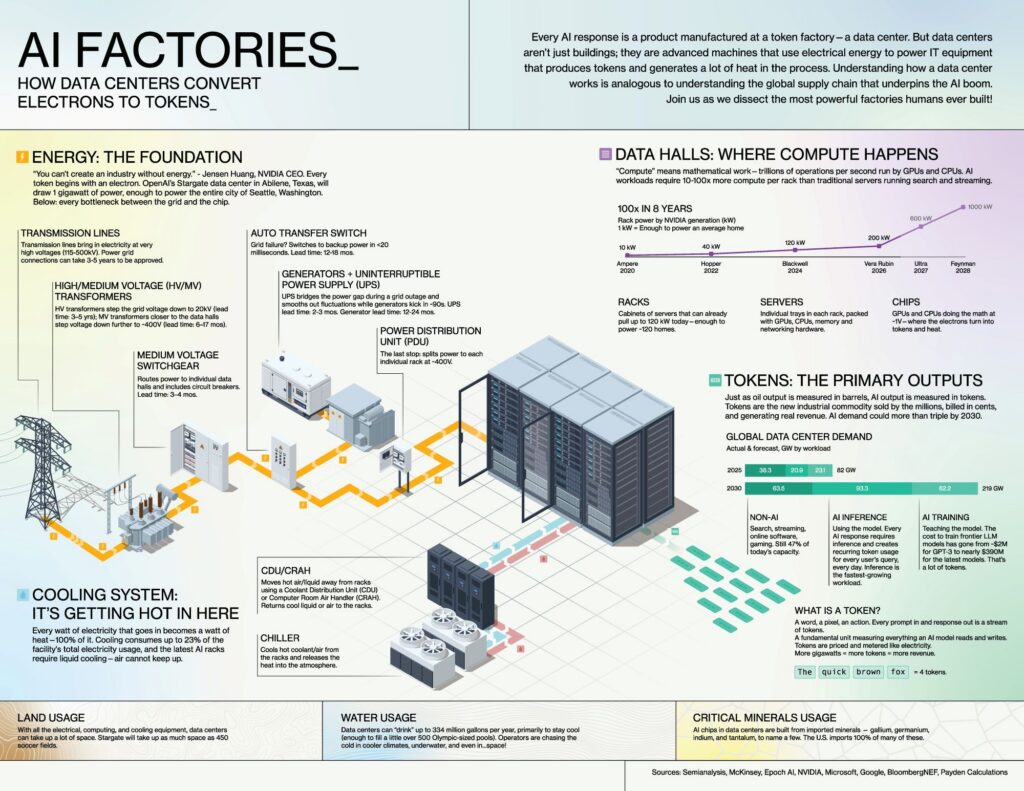
As shown in the diagram, energy is the foundation of data centers. Every AI token begins with electricity and large AI data centers require gigawatt-scale power. There are several stages for energy and power, as outlined, ranging from transmission lines to HV/MV transformers, to medium-voltage switchgear, to automatic transfer switch, to generators and uninterruptible power supply and power distribution units. The market takeaway is that any of the components or systems of the energy process are potential bottlenecks – not just merely the supply of advanced chips.
Then we can see cooling systems. As the piece explains, cooling can represent as much as 23% of a data center’s total electricity consumption. Cooling is comprised of CDU/CRAH systems as well as chillers. As rack power rises, cooling becomes a core part of AI infrastructure spending and facility design.
And then there are data halls which are the production floor of the AI factory. Data halls are made up of racks which organize and power groups of servers. There are servers which contain GPUs, CPUs, memory, networking equipment, and storage. And there are of course chips which perform the mathematical operations which convert electricity into computation, tokens and heat. Importantly, AI rack power is projected to increase dramatically – 100x in eight years.
Finally there are tokens. As the piece explains, tokens are, “a word, a pixel, an action. Every prompt in and response out is a stream of tokens. A fundamental until measuring everything an AI model reads and writes. Tokens are priced and metered like electricity. More gigawatts = more tokens = more revenue.” – Payden&Rygel Ultimately AI monetizations depends on converting costly physical infrastructure into high volumes of economically valuable tokens.
And then on top of that, it’s important not to forget the land usage, the water usage, and of course the usage of critical minerals in the development and support of data centers.
In terms of what this means for investors, we all need to remember and recognize – as the diagram shows – AI is a capital-intensive industrial system. Chips receive the attention, but the AI boom also depends on electricity, grid equipment, cooling, land, water, and critical minerals—and constraints anywhere in that chain can limit token production which is the main driver of revenue. But again, this complex ecosystem also provides many opportunities for investors to participate in the AI megatrend.
We would ask that you review the attached piece at your convenience and please let us know if you have any questions or if you would like to discuss it further. And as we always end this correspondence, please remember that regardless of current momentum and regardless of the key takeaways in this weekly perspective, we will continue to monitor and manage with a thoughtful approach based on your specific long-term objectives.


