
What we learned last week:
“I’m gonna teach you to hate spending money. I’m gonna make you so sick of spending money that the mere sight of it will make you wanna throw up!” – Robert Horn, in 1985 comedy film “Brewster’s Millions”
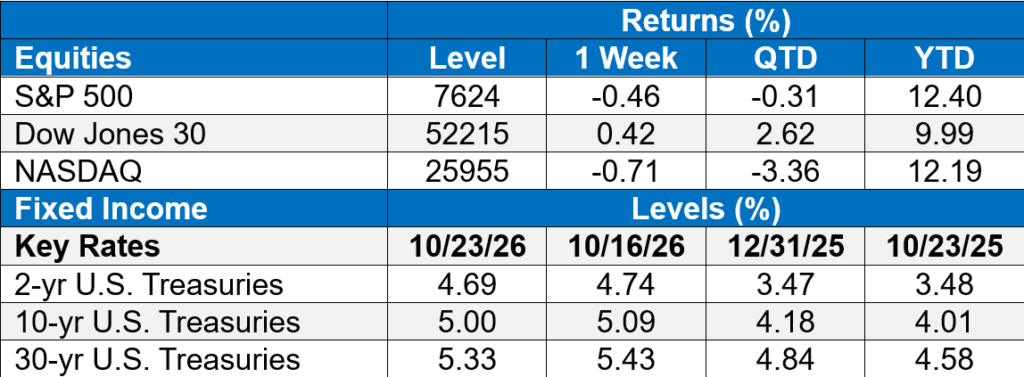
Sentiment around tech and the artificial intelligence complex was last week’s focal point pulling the S&P 500 and Nasdaq composite lower for a second straight week.
Several tech companies reported earnings last week and post earnings reaction have been negative, with the higher spending theme weighing on outlook.
An important participant in the AI economy, Meta, kicked off tech earnings after the market closed on Wednesday. They reported an all-time high of $64 billion for the quarter, exceeding analyst’s expectations by $700 million and last year’s same quarter revenue by almost $13 billion.
Meta CEO Mark Zuckerberg highlighted expectations for profitability growth from the companies recently released personal AI agent Muse. Zuckerberg says 10 million people in the US and Canada have set up the app and once compute efficiency improves expects to eventually have more than one billion people on the service.
What concerns are there given the record high revenue?
In an effort to support this growth Meta said it has agreed to spend about $825 billion in the future, much of it related to computing power and infrastructure for artificial intelligence.
Shares of Meta traded lower as higher spending raises concerns.
Thursday shares of Meta and Tech’s biggest spenders experienced sharp declines as investors moved into more defensive sectors, healthcare, consumer staples, and U.S. Treasuries.
The move to the safe-haven treasuries pushed the 10-year U.S. Treasury below 5% for the first time since Sept. 23 and Thursday the yield saw its biggest one-day decline since March 10, 2023.
Not to long ago, (the first week of October) investors were selling U.S. Treasuries fueling a rapid rise in rates.
Adding to the concerns over spending on artificial intelligence was geopolitical tensions. Brent Crude topped $111 per barrel Thursday to its highest level since May after reports from the New York Times the US and Isreal have reportedly drawn up plan for renewed attacks on Iran after the November elections. Additionally, Saudi Arabia reported attacks at the airport of Dammam and an Aramco oil field.
AI debt concerns and middle east tensions will likely continue to be in focus. The midterm elections are fast approaching, backlash to data centers has built up among the concerns of investors. Playing prominently this week is the quarterly earnings of several more companies in the AI economy along with companies across several sectors and industries. There is also a Federal Reserve decision and press briefing on interest rates that investors will be watching closely.
What’s ahead this week:
Economic Events
- Tuesday’s Federal open Market Committee meeting has is expected to keep rates at their current level
- Thursday’s Personal Consumption Expenditures report captures a wide range of price changes and consumer spending changes will drive a market reaction for the December Fed meeting
Earnings
- Big week for earnings as many blue-chip names report alongside Mag 7 and AI companies
- Verizon, Coca-Cola, Boeing, UPS and FedEx, and Caterpillar are several blue-chip companies
- Along with Mag 7 names Google, Microsoft, and Amazon, other AI themed companies report this week: GE’s power company GE Vernova, chip makers Intel and Sandisk, and fiber optics producer Corning kicks of tech earnings this week
- The healthcare sector has several notable companies reporting, GE Healthcare, Merk, Bristol Myers, and Abbvie.
- Friday two companies in the Energy sector close out the week in earnings for S&P 500 companies, Exxon and Chevron
My goal is for you to feel educated and informed about variables we do and don’t have control over and find ourselves working within. I hope to do it in an informative and relatable way. As always, I value your relationship and planning objectives – my door is always open for conversation.


