
Midterm elections are just around the corner, so as political headlines grow louder, it can be tempting for investors to reconsider investment decisions based on the latest predictions. So today’s weekly market commentary examines how stocks have historically performed around midterm elections and reminds investors why a long-term perspective remains valuable during campaign season.
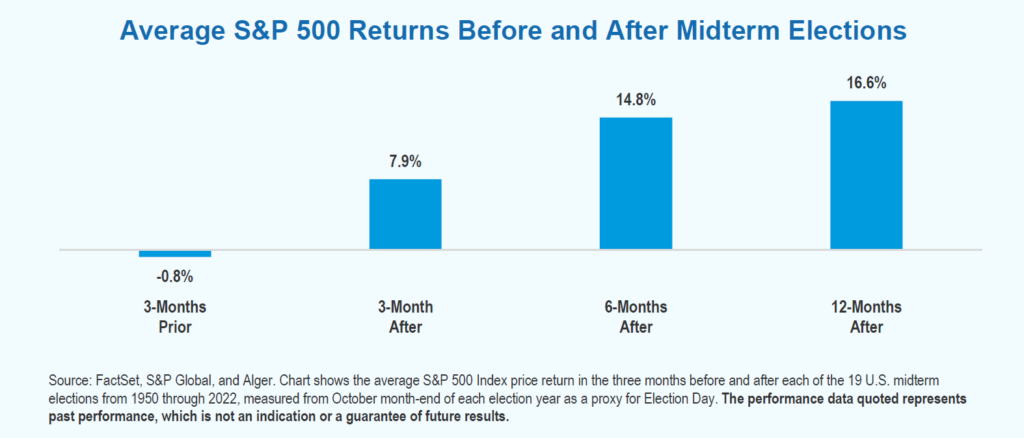
The enclosed chart plots the average return of the S&P 500 before and after midterm elections. The data runs from 1950 through 2022, covering each of the 19 U.S. midterm elections during that time period. Values are measured from October month-end for each midterm election year. As can be seen from the chart, the average return of the S&P 500 in the three months leading up to midterm elections is -0.8%. History shows, however, that after midterm elections, returns are much stronger. Three months post-election, the average return is 7.9%. The six-month figure is 14.8%, and one year post election is 16.6%.
Stronger post-election returns potentially may be explained by greater clarity around taxes, spending, and regulation. As we have discussed in the past, financial markets dislike uncertainty, and campaign proposals can certainly create uncertainty. But investors must remember that policies ultimately enacted often differ from campaign promises.
But the key takeaway from the piece, and as we have discussed in the past, is that “regardless of outcome, we caution against repositioning portfolios around election results. Congress changes hands every few years, while the forces driving corporate earnings play out over decades. Artificial intelligence (AI) offers a timely example. Demand for AI workloads continues to outstrip the infrastructure to support it, and political opposition that slows data center construction may extend the buildout rather than end it, reducing the risk of overbuilding along the way. In our view, companies with durable competitive advantages at the forefront of such innovation may be well positioned to deliver long-term shareholder value, whichever party controls Washington.” – AOM 492
Ultimately, election outcomes can influence policy, but the forces behind business growth and innovation often span many election cycles.
We would ask that you review the attached piece at your convenience and please let us know if you have any questions or if you would like to discuss it further. And as we always end this correspondence, please remember that regardless of current momentum and regardless of the key takeaways in this weekly perspective, we will continue to monitor and manage with a thoughtful approach based on your specific long-term objectives.
Thank you for your continued confidence and look forward to speaking soon.


